People have joined metal with heat for thousands of years, but welding as we know it is less than 150 years old. Here are a few of the people who made the arc, the flame and the electrode work.
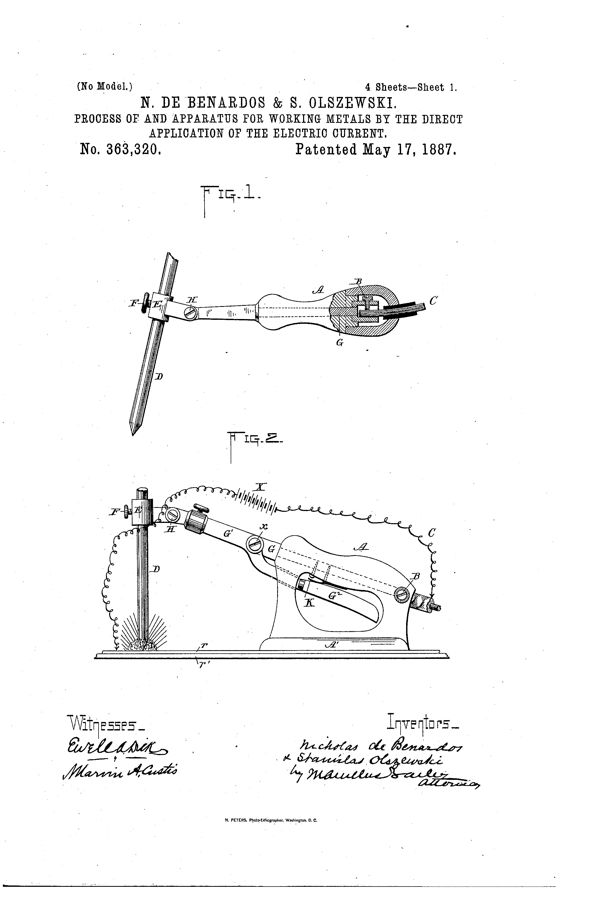
Drawing from US patent 363,320 by Benardos and Olszewski, granted 17 May 1887Nikolay Benardos and Stanisław Olszewski (patent drawing), 1887. Public domain (US patent drawing). United States Patent and Trademark Office via Google Patents. Image source
Benardos and Olszewski strike an arc
1881 to 1887 · Nikolay Benardos and Stanisław Olszewski
In 1881, at a laboratory in France, the engineer Auguste de Méritens used the heat of an electric arc to join lead plates for storage batteries. Working in the same lab was a young engineer from the Russian Empire, Nikolay Benardos.
Benardos saw that the arc could do much more. With his partner Stanisław Olszewski he developed a method that used a carbon rod as one electrode and the metal being worked as the other. The arc that jumped between them was hot enough to melt the metal, so pieces could be joined or holes filled.
The pair patented their process in several countries, including Britain in 1885 and the United States, where patent 363,320 was granted on 17 May 1887. The drawings show an early electrode holder, an ancestor of the stinger in your hand today.
Carbon arc welding had its problems. The arc was hard to control and the carbon could get into the weld. Within a few years others tried bare metal electrodes instead, and later coated ones. But Benardos and Olszewski proved that electricity could weld, and every arc process since builds on that start.
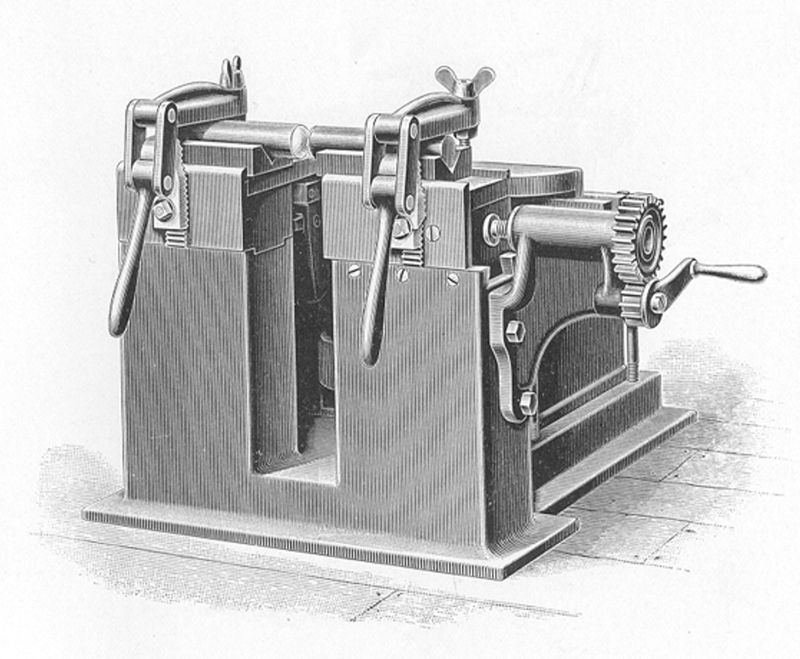
Thomson electric welding machine, from a company catalogue of about 1890Thomson Electric Welding Company, About 1890. Public domain. Wikimedia Commons. Image source
Elihu Thomson welds with resistance
1886 · Elihu Thomson (1853 to 1937)
Elihu Thomson was born in Manchester, England in 1853 and grew up in Philadelphia, where he taught chemistry and mechanics at Central High School. With fellow teacher Edwin Houston he designed an arc lighting system, and their work grew into the Thomson-Houston Electric Company of Lynn, Massachusetts.
Thomson knew that when a large current passes through a joint between two pieces of metal, the resistance there turns the current into heat. He used this to weld. Two bars were clamped end to end and a heavy current at low voltage was sent through them. The joint heated until the metal softened, and the bars were pressed together to forge a solid weld. No flame and no filler metal were needed.
He applied for a US patent on 29 March 1886, his 33rd birthday, and patent 347,140 was granted on 10 August 1886. By about 1890 the Thomson Electric Welding Company was making machines like the one pictured.
Thomson held around 700 patents in all, and his company became part of General Electric in 1892. Resistance welding grew into spot, seam, projection and flash butt welding, and it still joins car bodies, wire and rebar today.
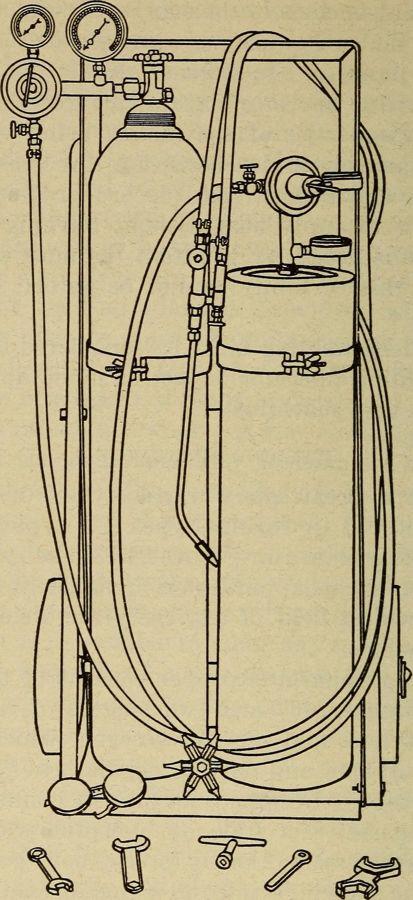
Oxy-acetylene welding outfit, from the Sheet Metal Workers' Manual (1918)L. Broemel and J. S. Daugherty, 1918. Public domain (no known copyright restrictions). Internet Archive Book Images via Flickr and Wikimedia Commons. Image source
Fouché and Picard tame the hottest flame
1895 to 1903 · Henry Le Chatelier (1850 to 1936), Edmond Fouché and Charles Picard
In 1895 the French chemist Henry Le Chatelier reported that acetylene burned with pure oxygen gives a flame hotter than any other common gas flame, more than hot enough to melt steel. The trouble was building a torch that would burn it steadily and safely.
On Le Chatelier's advice, the engineer Charles Picard began working on an oxygen and acetylene burner in 1899. He teamed up with the engineer Edmond Fouché, and in March 1901 they got a stable flame that would stay lit at the tip.
In 1902 Fouché patented a low-pressure torch that metered the two gases. Industrial use of oxy-acetylene welding is usually dated from 1903. Within a few years, workshops and shipyards were using the process to weld and cut steel, and textbooks like the one pictured were teaching it to tradesmen.
Oxy-fuel welding was easy to carry around and needed no electricity, so it became one of the most popular welding methods of the early 1900s. Arc processes later took over most production welding, but the oxy-acetylene torch is still used for cutting, heating, brazing and repairs.
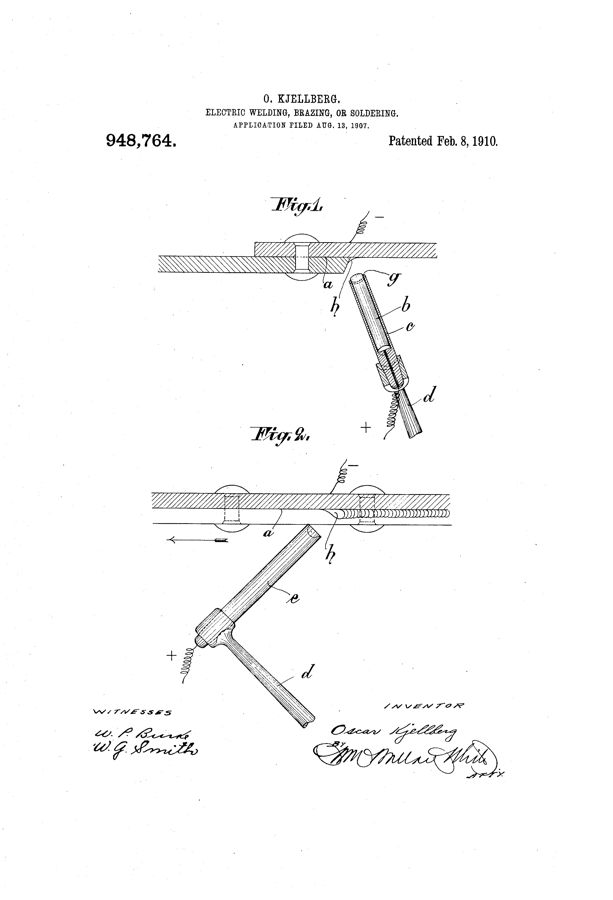
Drawing from Oscar Kjellberg's US patent 948,764 for electric welding with a coated electrode, filed 1907, granted 8 February 1910Oscar Kjellberg (patent drawing), 1910. Public domain (US patent drawing). United States Patent and Trademark Office via Google Patents. Image source
Oscar Kjellberg coats the electrode
1904 · Oscar Kjellberg (1870 to 1931)
In the early 1900s Oscar Kjellberg was working as chief engineer on a steamship. The ship's steam plant kept leaking and needed constant repair, and the welding methods of the day did not satisfy him.
Kjellberg rented a small workshop in Gothenburg and started experimenting. His answer was to dip the electrode wire into a coating made from a mixture of minerals and other chemicals. As the electrode burned, the coating helped steady the arc and protect the molten metal, giving a sounder weld.
In 1904 he and a group of investors founded Elektriska Svetsnings-Aktiebolaget, ESAB, which began repairing ships in Gothenburg harbour. Sources give different years for his first electrode patent: Tekniska museet and ESAB say 1904, while TWI dates his invention to between 1907 and 1914. His US patent, pictured here, was filed in 1907 and granted in 1910. What they agree on is that Kjellberg's coated electrode changed manual arc welding.
ESAB grew into one of the world's big welding companies, and Kjellberg ran it until he died in 1931. A bust of him stands outside the maritime museum in Gothenburg. Every time you strike up with a stick electrode, the flux on the outside is his idea at work.
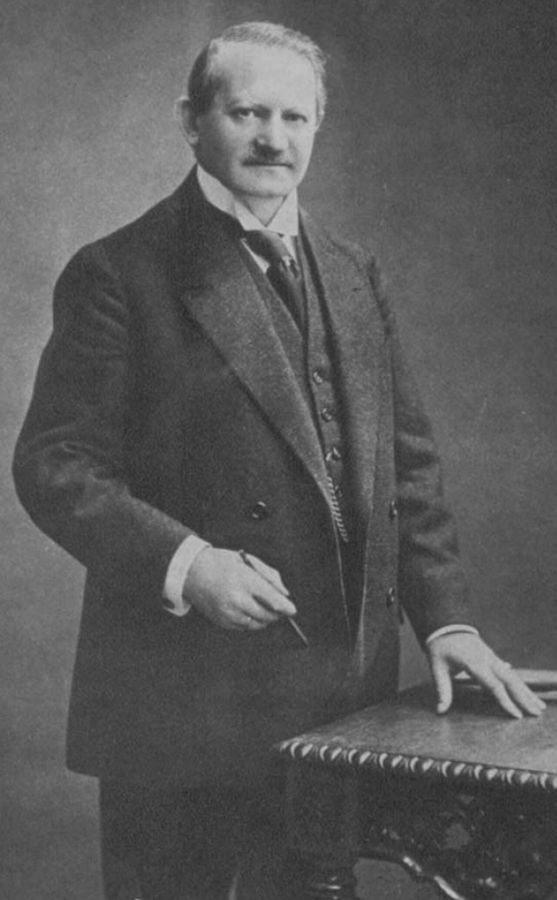
Hans Goldschmidt, about 1916Unknown photographer, About 1916. Public domain. Angewandte Chemie obituary (1923) via Wikimedia Commons. Image source
Hans Goldschmidt welds the rails
1893 to 1899 · Hans Goldschmidt (1861 to 1923)
Hans Goldschmidt was a German chemist who ran his family's chemical company in Essen. In 1893 he began studying reactions between metal oxides and aluminium powder. Once started, the mixture burns by itself at around 3,000 degrees Celsius, hot enough to leave molten metal behind.
He was trying to make pure metals such as chromium and manganese, but he saw that a mix of aluminium and iron oxide produced a small pool of liquid steel. That steel could be poured into a mould around the ends of two pieces of metal and fuse them together. He patented the aluminothermic process in 1895 and called the mixture Thermit.
In 1899 Goldschmidt received a German patent for aluminothermic butt welding, and the first rail welds with Thermit were made for the tramways in Essen. Until then rails were joined with bolted fishplates, which clacked and wore out. Welded track was smoother and quieter. By the First World War, Thermit welding had become the standard for tram track, and mainline railways followed in later decades.
Goldschmidt died in 1923. The Thermit process is still used to weld railway track around the world, with a crucible, a mould and a spectacular, controlled burn.