Plumbers bring clean water in and carry waste away safely, and that work has saved more lives than almost any other. Here are a few of the people who shaped the trade.
Title page of an edition of Frontinus's works printed at Zweibrücken in 1788Societas Bipontina (publisher), engraver unknown, 1788. Public domain. Wikimedia Commons. Image source
Frontinus, Rome's water commissioner
97 to about 103 AD · Sextus Julius Frontinus (about 35 to about 103 AD)
Ancient Rome ran on water. Aqueducts carried it into the city, and pipes made of lead took it to fountains, baths and some private homes. The Latin word for lead was plumbum, and that is where our word plumber comes from.
In 97 AD a senior Roman named Sextus Julius Frontinus was put in charge of the city's water supply as water commissioner. He had already served as consul and as governor of Britain.
Frontinus did not want to run the job by just following his assistants. He went out and checked things himself, and he wrote a report now known as De aquaeductu, about the aqueducts of Rome. It lists each aqueduct, where its water came from and how far it ran. It explains the standard sizes of pipe used to hand out water, and the rules and penalties that protected the system.
He also found problems any plumber would recognise: leaky reservoirs, fittings bigger than allowed, and secret branch pipes bored into the mains by people he called puncturers. He set out to stop them.
His little book survived, and it is still one of the best records of how a big city's water system worked nearly two thousand years ago.
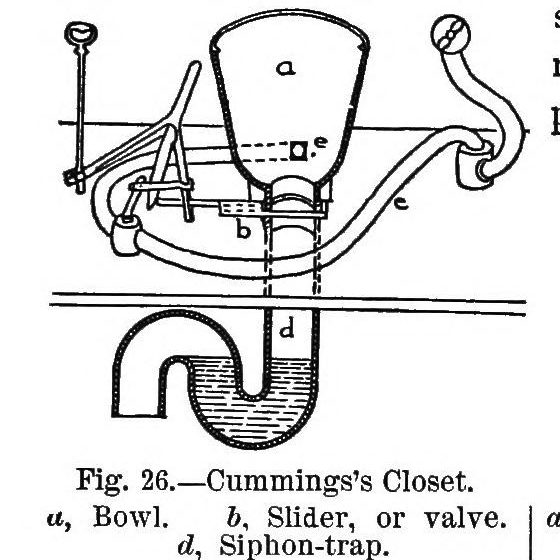
Cumming's closet of 1775, Fig. 26 in Glenn Brown's Water-Closets (1884)Glenn Brown, 1884. Public domain. Cornell University Library via Internet Archive. Image source
Alexander Cumming bends the pipe
1775 · Alexander Cumming, watchmaker, and Joseph Bramah (1748 to 1814)
In the 1700s a toilet connected to a drain had a nasty problem. The pipe was open to the drain, so the smell came straight back up into the house.
Alexander Cumming was a Scottish watchmaker and instrument maker working in London. In 1775 he was granted British patent number 1105, the first British patent for a flushing water closet.
His key idea was in the pipe under the bowl. He bent it into an S shape, so that some water always stayed sitting in the bend. That little pool of water sealed the pipe and kept the smell from the drain out of the room. His patent also said the water in the trap should be emptied and replaced every time the closet was used.
Others soon improved on his design. Joseph Bramah, who had fitted Cumming's closets, patented a better valve in 1778.
Very few homes had running water or sewers to connect to in 1775, so flushing toilets stayed rare for a long time. But the water seal caught on. Every trap under a sink, tub or toilet today still works on the same simple idea.
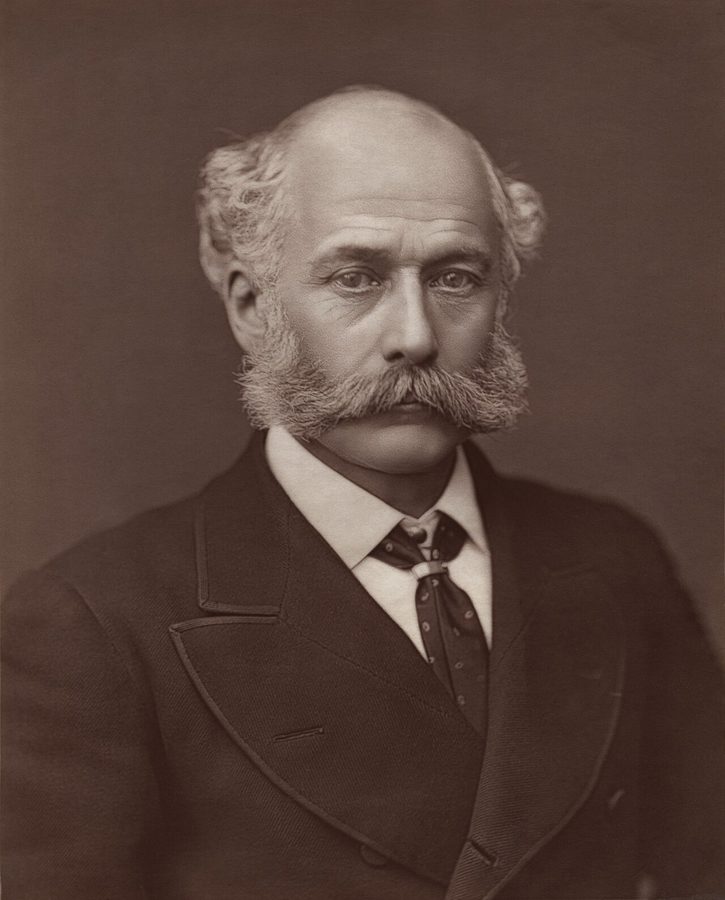
Sir Joseph Bazalgette, photographed by Lock and WhitfieldLock and Whitfield, between 1864 and 1877. Public domain. National Portrait Gallery, London, via Wikimedia Commons. Image source
Joseph Bazalgette ends the Great Stink
1858 to 1875 · Sir Joseph Bazalgette (1819 to 1891)
In the 1850s most of London's waste ran into the River Thames, the same river many people drew water from. Cholera kept breaking out. In the hot summer of 1858 the river smelled so foul that it became known as the Great Stink, and it reached right into the Houses of Parliament.
Parliament quickly passed a law to pay for a fix. The man in charge was Joseph Bazalgette, chief engineer of the Metropolitan Board of Works.
His plan caught the old sewers before they reached the river. More than a thousand miles of street sewers fed into 82 miles of large brick intercepting sewers. These carried the waste east, away from the centre of the city, with the help of big steam pumping stations at places like Crossness and Abbey Mills.
Bazalgette insisted on strong Portland cement and built the tunnels bigger than London needed at the time, to allow for growth. The main system was officially opened in 1865 and finished in 1875. He was knighted in 1874.
Much of his brickwork is still part of London's sewers today.
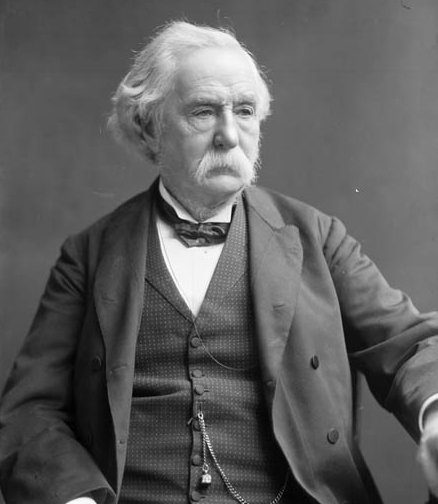
Thomas Coltrin Keefer, photographed by William James Topley, December 1904William James Topley (1845 to 1930), 1904. Public domain. Library and Archives Canada via Wikimedia Commons. Image source
Thomas Keefer brings water to Hamilton
1856 to 1859 · Thomas Coltrin Keefer (1821 to 1915)
In the 1850s Canadian towns were growing fast, and fire and disease were constant dangers. Clean water, piped under pressure, helped fight both.
Thomas Coltrin Keefer was born in Thorold Township, in what is now Ontario, in 1821. He learned engineering on the Erie and Welland canals. In 1853 he was hired to plan Montreal's waterworks, and that success brought calls from other cities.
Hamilton hired Keefer to build its waterworks between 1856 and 1859. He chose steam pumps to lift water from Lake Ontario up to a reservoir on the Hamilton mountain. The two pumping engines were assembled by John Gartshore's foundry in nearby Dundas, and they sat in an elegant stone pumphouse that Keefer designed. After new boilers were added in 1882, the station could pump more than five million gallons a day.
Keefer went on to help found the Canadian Society of Civil Engineers in 1887 and served as its first president.
The Hamilton pumphouse and its restored engines are a National Historic Site of Canada, open to visitors today as the Hamilton Museum of Steam and Technology.
Cover of Roy B. Hunter's report BMS65, Methods of Estimating Loads in Plumbing Systems (1940)US National Bureau of Standards, 1940. Public domain (US government work). National Institute of Standards and Technology (NIST). Image source
Roy Hunter invents the fixture unit
1940 · Roy B. Hunter, US National Bureau of Standards
Picture a building with a hundred sinks, toilets and tubs. If every one ran at once, you would need huge pipes. But they almost never do. So how big should the pipes be?
Roy B. Hunter, an engineer at the US National Bureau of Standards, worked on that question. In December 1940 the Bureau published his report, Methods of Estimating Loads in Plumbing Systems.
Hunter gave each kind of fixture a load weight called a fixture unit, based on how much water it uses, how long it runs and how often it is used. Then he used the mathematics of probability to work out how many fixtures are likely to be running at the same moment. Add up the fixture units for a building, read the chart, and you get a sensible design flow. His chart became known as Hunter's curve.
His method was taken into plumbing codes and has been used to size water and drain pipes for more than 80 years.
Modern low-flow fixtures use less water than those of 1940, so newer methods are now being added to some codes. But when you count fixture units on an exam, you are using Hunter's idea.