Millwrights started out building and fixing the mills that ground grain and sawed lumber. Here are a few of the people and ideas that shaped the trade.
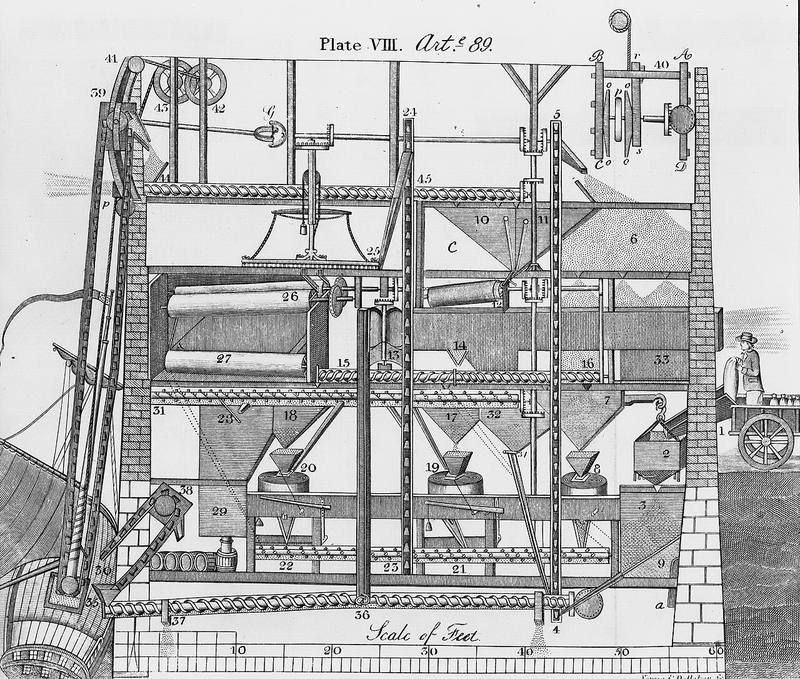
Plate from The Young Mill-Wright and Miller's Guide (1795)James Poupard, for Oliver Evans, 1795. Public domain. Library of Congress (cph.3c10379) via Wikimedia Commons. Image source
Oliver Evans and the mill that ran itself
1780s to 1795 · Oliver Evans (1755 to 1819)
In the 1780s, running a flour mill was back-breaking work. Workers hauled heavy sacks of grain up to the top floor, then shovelled warm, damp meal across the floor so it could cool and dry before sifting.
Oliver Evans, born in 1755 near Newport, Delaware, was apprenticed to a wheelwright at 16. In the 1780s he set out to let the machinery of a flour mill do the carrying. He used bucket elevators to lift grain from floor to floor, conveyors to move it sideways, and a slowly turning rake he called the “hopper boy” to spread and cool the meal.
Linked together and driven by the waterwheel, these machines took grain in at one end and delivered finished flour at the other. People only had to start the mill and keep an eye on it. By Evans's own reckoning it cut the cost of milling about in half, and historians see it as one of the first continuous, automatic production lines.
On 18 December 1790 Evans received only the third patent ever granted by the United States. In 1795 he published The Young Mill-Wright and Miller's Guide, packed with plates like the one above. It went through 15 editions by 1860 and taught millwrights for generations.
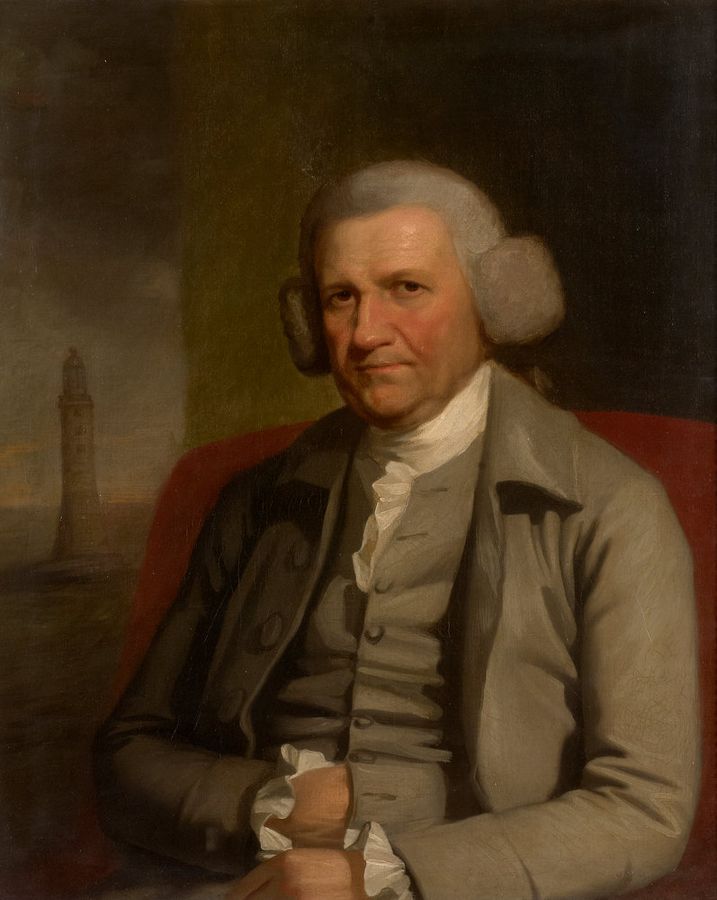
John Smeaton, after a portrait by Mather BrownMather Brown (painter), 18th century. Public domain. Smithsonian Libraries via Wikimedia Commons. Image source
John Smeaton puts the waterwheel to the test
1750s · John Smeaton (1724 to 1792)
For centuries, millwrights built waterwheels from experience and rules of thumb. John Smeaton, born in 1724 near Leeds, England, wanted numbers instead.
Smeaton started out making scientific instruments in London. In the 1750s he built small working models of waterwheels, with a pump to recirculate the water and a pan of weights to measure how much work each wheel could do. He tested one setup after another and wrote down the results.
His big finding: an overshot wheel, where water pours onto the top and its weight turns the wheel, gave roughly twice the output of an undershot wheel, where the stream just pushes the bottom paddles. Mills that switched could get much more power from the same stream.
In 1759 he presented the work to the Royal Society in London in a paper on the power of water and wind to turn mills. It won him the Society's Copley Medal, one of the top science prizes of the day.
Smeaton also brought cast-iron shafts and gearing into windmills and water mills, replacing parts that had been made of wood. He went on to build the Eddystone Lighthouse and, in 1771, founded the Society of Civil Engineers. Testing before building is still how good millwrights work.
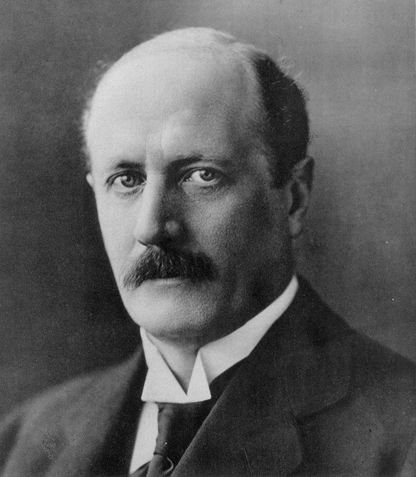
Sven Wingquist, 1926Unknown studio photographer, published in Veckojournalen no. 27, 1926. Public domain. Wikimedia Commons. Image source
Sven Wingquist and the bearing that could tilt
1907 · Sven Wingquist (1876 to 1953)
Sven Wingquist was born in Sweden in 1876. In 1899 he took a job as an operating engineer at the Gamlestaden textile mill in Gothenburg, where he looked after repairs and maintenance.
The mill had a problem any millwright would recognise. Gothenburg is built on clay, and the factory floor shifted bit by bit. Long drive shafts fell out of line, and the stiff ball bearings of the day overheated and failed. Every failure meant shutting down production and a fire risk.
Wingquist worked on the problem in a small test shop at the mill. In 1907 he came up with the double-row self-aligning ball bearing. Two rows of balls run in an outer ring shaped on the inside like part of a sphere, so the inner ring and shaft can tilt a little without binding or overloading the balls.
The same year the mill's owners backed a new company, Svenska Kullagerfabriken, better known as SKF, founded on 16 February 1907. Wingquist was its first managing director, and the bearing was patented in ten countries.
Self-aligning bearings are still a go-to choice wherever shafts can flex or supports can shift a little.
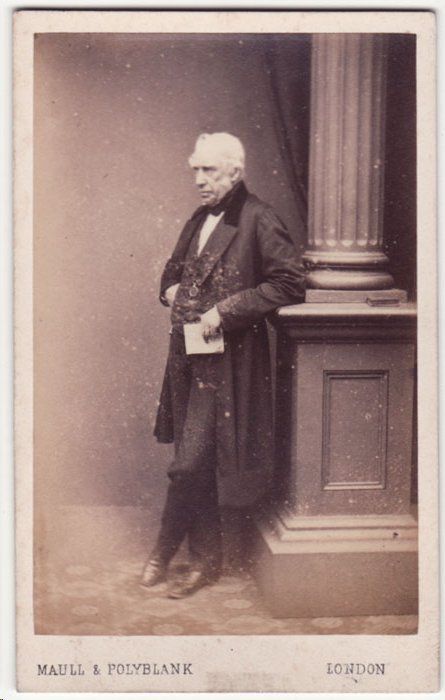
William Fairbairn, carte de visite by Maull and Polyblank, 1850s to 1860sMaull and Polyblank, Between 1854 and 1865. Public domain. Wikimedia Commons. Image source
William Fairbairn speeds up the line shaft
1817 to 1861 · William Fairbairn (1789 to 1874)
William Fairbairn was born in Kelso, Scotland in 1789. From 1804 to 1811 he served an apprenticeship as a millwright at Percy Main colliery near Newcastle upon Tyne, then worked as a journeyman millwright. In 1813 he settled in Manchester, a booming cotton town.
In 1817 he and a former shopmate, James Lillie, started their own millwright business. They rented a small shed and worked on a lathe they had built themselves. Orders came in slowly at first.
Their break came in 1818, when they were hired to fit out the drive shafts and gearing for a large new cotton mill built by McConnel and Kennedy. Mills of the time used heavy, slow-turning main shafts. Fairbairn put in lighter wrought-iron shafts running at much higher speed, so the same engine could drive more machines with less weight and friction. Light, fast shafting became the usual practice in Lancashire mills.
Fairbairn went on to build waterwheels, iron ships, boilers and bridges. With John Hetherington he patented the Lancashire boiler in 1844. Between 1861 and 1863 he published his Treatise on Mills and Millwork, a standard text for engineers. He was made a baronet in 1869 and died in 1874, still remembered as a millwright first.
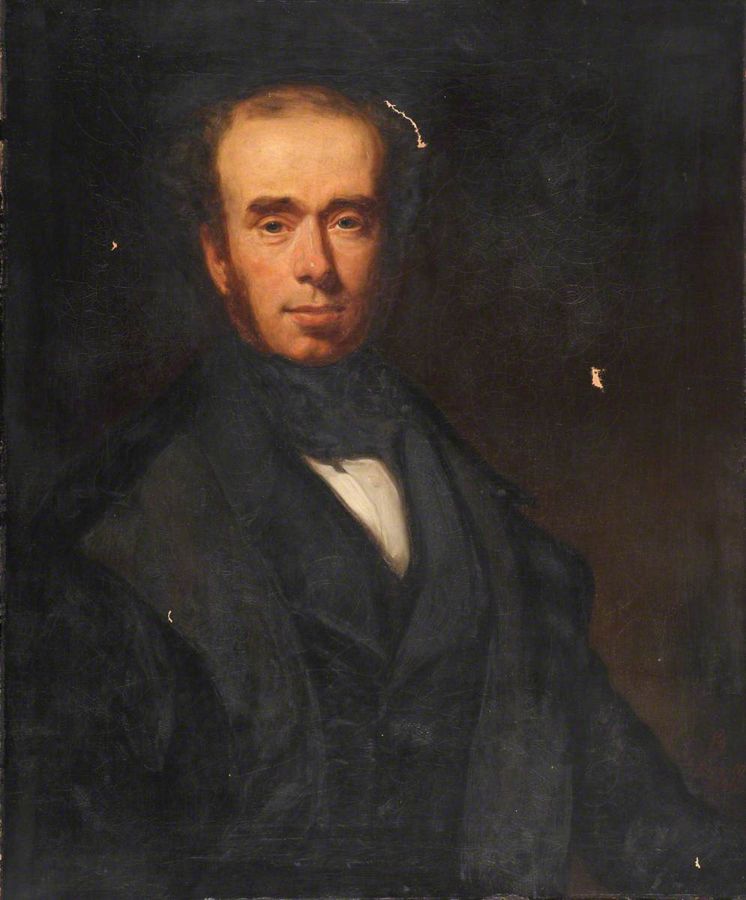
Joseph Whitworth, from a portrait of 1846Unknown artist, 1846. Public domain. Art UK via Wikimedia Commons. Image source
Joseph Whitworth standardises the screw thread
1841 · Joseph Whitworth (1803 to 1887)
In the early 1800s every engineering shop cut its own screw threads. A bolt from one maker rarely fitted a nut from another. If you were fitting engines from several makers, you needed a different set of taps, dies and spares for each.
Joseph Whitworth was born in Stockport, England in 1803. He worked as a mechanic in Manchester, then from 1825 at Henry Maudslay's works in London, where he developed a method of scraping metal to a true flat surface. In 1833 he opened his own toolmaking business in Manchester.
In 1841 he presented a paper to the Institution of Civil Engineers, On an Uniform System of Screw Threads. He had collected screw bolts from the main workshops throughout England and measured them. Taking the average, he proposed one thread angle of 55 degrees for every size, with the tops and bottoms rounded off, and a set number of threads per inch for each diameter.
His system was taken up by many British railways and engineering works, and at Woolwich. Whitworth also built precise measuring machines and master gauges, showed his machine tools at the 1851 Great Exhibition, and in 1868 set up the Whitworth scholarships for young engineers. Whitworth threads are still found on older British machinery today.