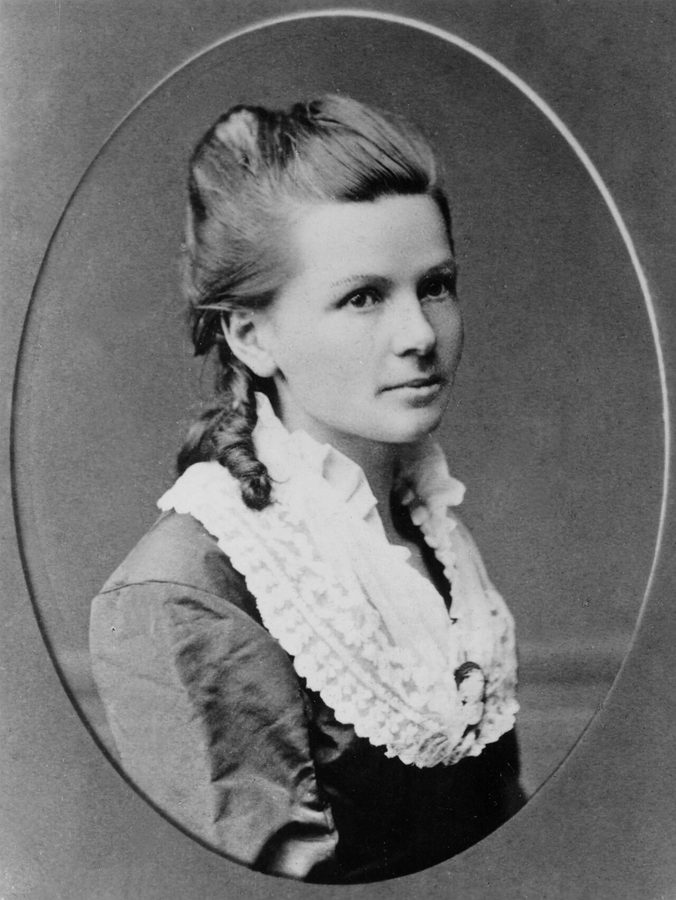
Bertha Benz, about 1871 to 1872Bühler studio, Mannheim, about 1871. Public domain. Automuseum Dr. Carl Benz, Ladenburg, via Wikimedia Commons. Image source
Bertha Benz takes the first long drive
1886 to 1888 · Bertha Benz (1849 to 1944) and Carl Benz (1844 to 1929)
On 29 January 1886 Carl Benz of Mannheim, Germany, filed a patent for a vehicle powered by a gas engine. German patent number 37435 is often called the birth certificate of the automobile. But few people wanted to buy his three-wheeled motor carriage. They did not believe it was practical.
His wife, Bertha Benz, had put her own money into his work. Early one morning in August 1888, she set out from Mannheim with their sons Eugen and Richard, aged 15 and 13. They drove a Benz Patent Motor Car to her home town of Pforzheim, about 100 km away, without telling Carl first.
The trip took most of a day. When fuel ran low, Bertha bought ligroin, a cleaning solvent, at the town pharmacy in Wiesloch, which is now remembered as the first filling station. On steep hills the boys had to help push.
Back home, Bertha suggested an extra, lower gear for climbing hills, and Carl added one.
Her drive showed the public that a car could make a real trip. The route is now marked as the Bertha Benz Memorial Route.
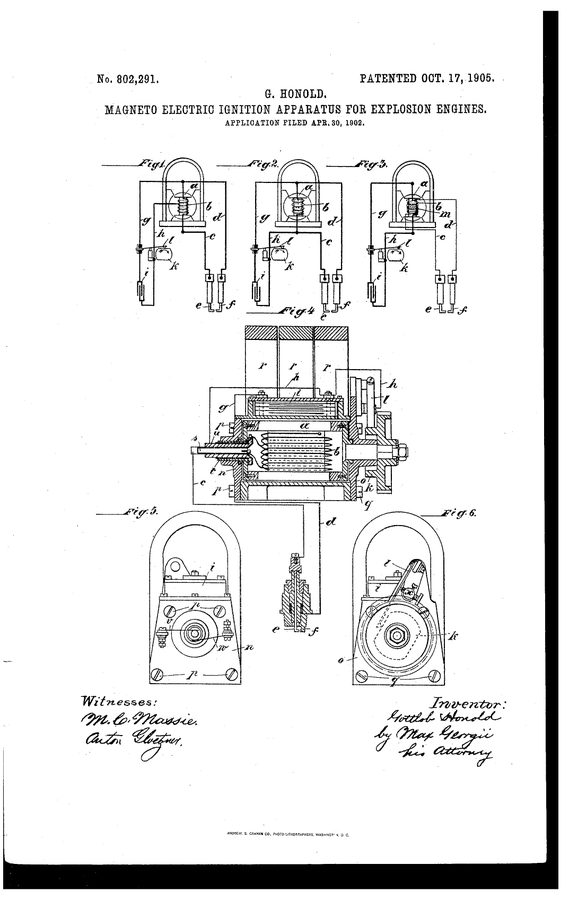
Drawing from US patent 802,291, magneto-electric ignition apparatus, by G. Honold (1905)Gottlob Honold (patent drawing), 1905. Public domain (US patent drawing). United States Patent and Trademark Office via Google Patents. Image source
Bosch and Honold light the spark
1901 to 1902 · Robert Bosch (1861 to 1942) and Gottlob Honold
Early car engines were hard to keep running. Many used a low-voltage magneto with moving contacts inside the cylinder that snapped apart to make a spark. The parts wore out and often let the driver down.
In 1901 Robert Bosch, who ran an electrical workshop in Stuttgart, Germany, asked his young engineer Gottlob Honold to find something better.
Honold's answer was a high-voltage magneto. Coils on the turning armature produced a high voltage, which was sent through a cable to a spark plug screwed into the cylinder. The spark jumped between two fixed electrodes, so nothing inside the combustion chamber had to move.
Bosch patented the system in Germany in January 1902, and a US patent followed in 1905, the drawing shown here. The high-voltage magneto with spark plug became a big success and helped turn Bosch into a major automotive supplier.
The parts have changed, but every gasoline engine you tune up still fires a spark across the gap of a plug.
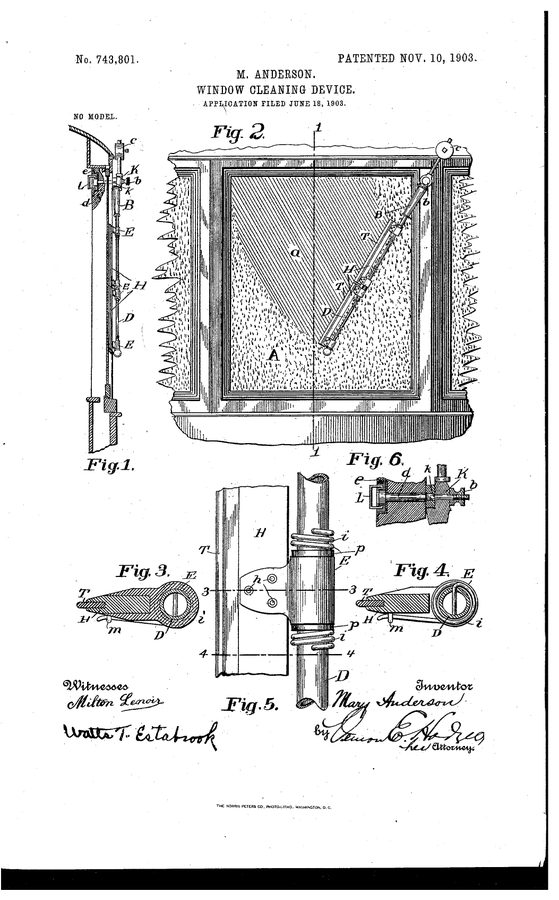
Drawing from Mary Anderson's US patent 743,801, granted 10 November 1903Mary Anderson (patent drawing), 1903. Public domain (US patent drawing). United States Patent and Trademark Office via Google Patents. Image source
Mary Anderson clears the windshield
1902 to 1903 · Mary Anderson (1866 to 1953)
On a winter visit to New York City in 1902, Mary Anderson of Birmingham, Alabama, noticed something. The streetcar driver kept stopping to clear snow and sleet off the front window, or drove with the window open.
Back home, she designed a fix. A lever inside the vehicle swung an arm with a rubber blade across the outside of the glass. A spring held the blade against the window, and it could be removed when the weather was fine.
Anderson was granted US patent number 743,801 for her window-cleaning device on 10 November 1903. She tried to sell the rights, but companies said it had little value, and the patent ran out before wipers became common.
As cars with glass windshields became common, wipers became standard equipment. In 2011 Anderson was inducted into the National Inventors Hall of Fame for her invention.
So the next time you replace a set of wiper blades, give a nod to Mary Anderson.
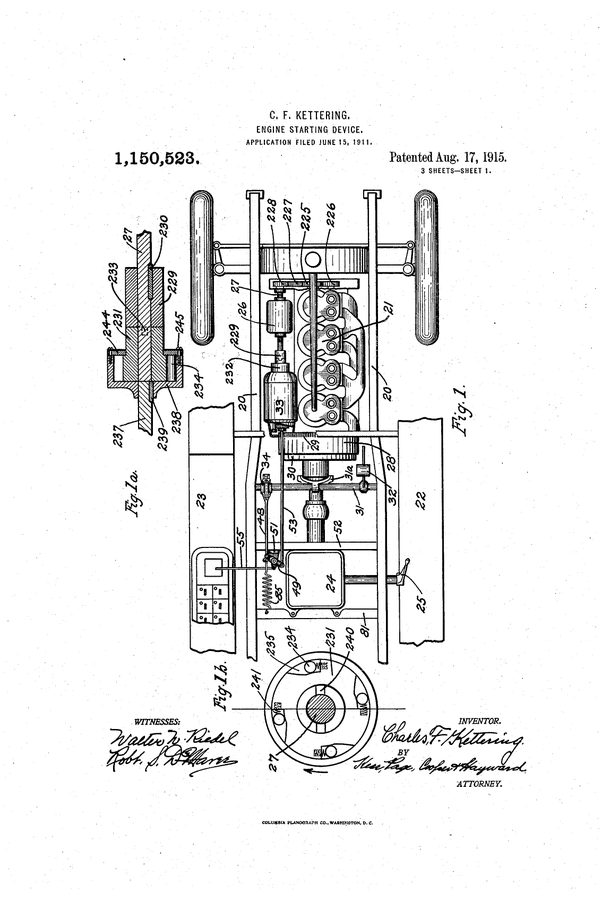
Drawing from Charles F. Kettering's US patent 1,150,523, engine-starting device, granted 17 August 1915Charles F. Kettering (patent drawing), 1915. Public domain (US patent drawing). United States Patent and Trademark Office via Google Patents. Image source
Charles Kettering retires the crank
1909 to 1912 · Charles F. Kettering (1876 to 1958), Edward A. Deeds and Henry M. Leland
Starting an early car meant turning a hand crank at the front. It took strength, and if the engine kicked back, the crank could break a wrist or an arm.
In 1909 Charles F. Kettering and Edward A. Deeds started the Dayton Engineering Laboratories Company in Dayton, Ohio. The name was shortened to Delco. Cadillac's leader, Henry M. Leland, wanted a safer way to start his cars, and Kettering's team took on the job.
The trick was size. Kettering's motor ran on a burst of high current for just a few seconds, so it could be small and light. Once the engine was running, the same unit worked as a generator to charge the battery and power the lights and ignition.
The 1912 Cadillac was the first production car with an electric starter. Cadillac won Britain's Dewar Trophy in 1913 for its electric starting, lighting and ignition system. Kettering's patent for the starting device was granted in 1915.
Every time you test a starter or charging system, you are working on Kettering's idea.
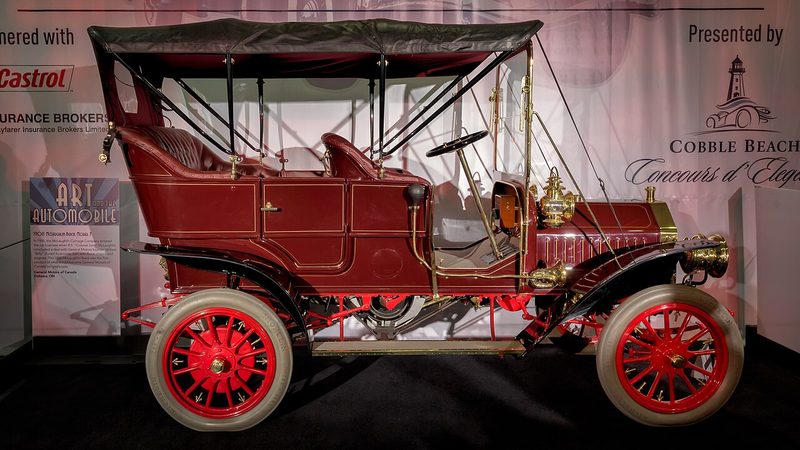
A 1908 McLaughlin-Buick Model F at the 2016 Toronto International Auto ShowJoe deSousa, 2016. CC0 1.0 (public domain dedication). Wikimedia Commons (from Flickr). Image source
Sam McLaughlin builds cars in Oshawa
1907 to 1918 · Robert Samuel McLaughlin (1871 to 1972) and George McLaughlin
Robert McLaughlin built horse-drawn carriages and sleighs. In 1876 he moved his business to Oshawa, Ontario, where the McLaughlin Carriage Company became one of the biggest carriage makers in the country.
His son Robert Samuel McLaughlin, known as Sam, could see that the motor car was coming. In 1907 Sam and his brother George formed the McLaughlin Motor Car Company. They made a deal with Buick in the United States to supply engines, while the McLaughlins built the bodies and the cars in Oshawa. The first McLaughlin-Buicks came out in 1908.
The company grew fast. From 1915 it also built Chevrolets in Canada. In 1918 General Motors bought the McLaughlin companies, and they became General Motors of Canada, with Sam McLaughlin as president.
Oshawa became one of Canada's great car-building towns. Sam McLaughlin lived to be 100, and his home, Parkwood, is now a National Historic Site.
A 1908 McLaughlin-Buick, like the one shown here, still turns heads at Canadian car shows.